
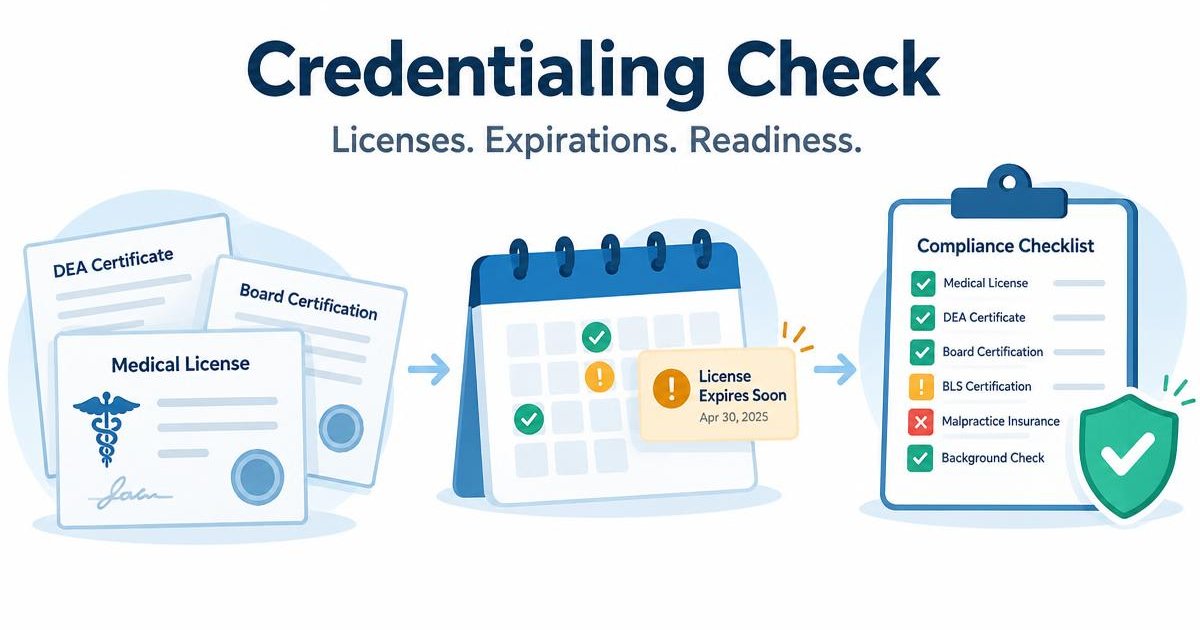
Picture this. Your best nurse is set to start Monday. The contract is signed, the hospital is ready — and then the call comes in. Her license expired last week. Nobody caught it.
The placement is dead. And the bill for that one missed date is much bigger than most agencies realize.
The direct hit: the placement itself
A single travel placement can be worth roughly $40,000 in revenue over the life of the contract. When a clinician is pulled — or never starts — because a credential lapsed, that revenue doesn't get delayed. It's gone, and the facility backfills the shift with a clinician from another agency.
The bigger hit: your client's problem becomes your reputation problem
Replacing one RN costs a hospital around $60,000 (Nurse.org, 2026) once you count recruiting, onboarding, orientation, and premium labor to cover the gap. Hospitals remember exactly which agency sent them the clinician whose license wasn't current. The next contract goes to the agency whose files are always clean.
Add the quieter costs:
-
Recruiter and coordinator time spent unwinding the placement, re-credentialing, and apologizing
-
Audit exposure — a lapsed license found by a Joint Commission or client audit puts every other file you submitted under a microscope
-
Clinician trust — your nurse loses income through no fault of her own, and she has ten other agencies texting her
Why it keeps happening
It's almost never carelessness. It's the system. The average agency discovers a lapsed license 90 days after it expires — when the placement is already dead. Why? Because the expiration date lives in a spreadsheet tab nobody opened, a calendar reminder somebody snoozed, or an email thread that got buried.
Spreadsheets don't chase anyone. They sit there, silently going stale.
How agencies actually prevent it
The fix isn't a bigger spreadsheet or a second coordinator hired to babysit one. It's three things:
-
Every credential, one place. Licenses, certifications, background checks, physicals, and hospital-specific documents tracked per clinician — not per folder, not per tab.
-
Automatic warnings before, not after. Your team and the clinician should get expiration reminders on a schedule — 60, 30, 14, 7, 3, and 1 day out — with a dashboard that shows what's expiring across the whole roster at a glance.
-
A verification trail. Who checked each document, when, and how (licensing board, registry, issuer's website, original document). When a hospital audits you, the answer is a click, not a weekend of digging through email.
Run your own math
How many clinicians are on your roster? How many expiration dates does each one carry — license, BLS, ACLS, background check, physical, immunizations? Multiply it out. That's how many chances per year your agency has to lose a $40,000 placement to a date nobody saw coming.
Credentialing Check was built to make that number zero: every clinician, every credential, every expiration in one dashboard, with automatic reminders before anything lapses.
Start free for up to 5 clinicians — no credit card, set up in minutes: https://credentialingcheck.com
Want the tracking template first? Download our free Clinician Credentialing Checklist — every document your team should be tracking, in one page.