
Forty-seven clinicians. Six spreadsheets. Zero expiration alerts.
Somewhere in tab four, a license is about to lapse — and nobody knows. If that sentence feels familiar, you're not doing anything wrong. You're just using a tool that was never built for this job.
The 5 ways a spreadsheet quietly fails your agency
-
It never reminds anyone of anything. A spreadsheet is a filing cabinet, not an alarm clock. It will happily store an expiration date and say nothing while the date passes. The system only works on the days somebody remembers to open it, sort it, and scan it — and those are exactly the busy days when nobody does.
-
It fragments the moment more than one person touches it. One coordinator keeps the "master" file. A recruiter keeps a copy. Someone emails a version called Roster_FINAL_v3.xlsx. Now there are three truths, and the clinician's renewed BLS is in the one nobody checks.
-
Documents live somewhere else. The license PDF is in a shared drive folder, the background check is in an email, the physical is in a filing cabinet. The spreadsheet says "on file" — until a hospital asks you to produce it and the scavenger hunt begins.
-
There's no audit trail. When a client or the Joint Commission asks who verified this license, and how? — a spreadsheet cell that says "✓" is not an answer. You need the verifier, the method, and the date, attached to the document itself.
-
It scales in the worst direction. Ten clinicians in a spreadsheet is manageable. A hundred clinicians, each with a license, two certifications, a background check, a physical, immunizations, and facility-specific forms — each with its own expiration date — is thousands of dates a human is expected to watch manually.
What "instead" actually looks like
Agencies that outgrow the spreadsheet don't need an enterprise platform built for hospital systems — five-figure contracts, months-long implementations, per-seat pricing. They need the middle ground:
-
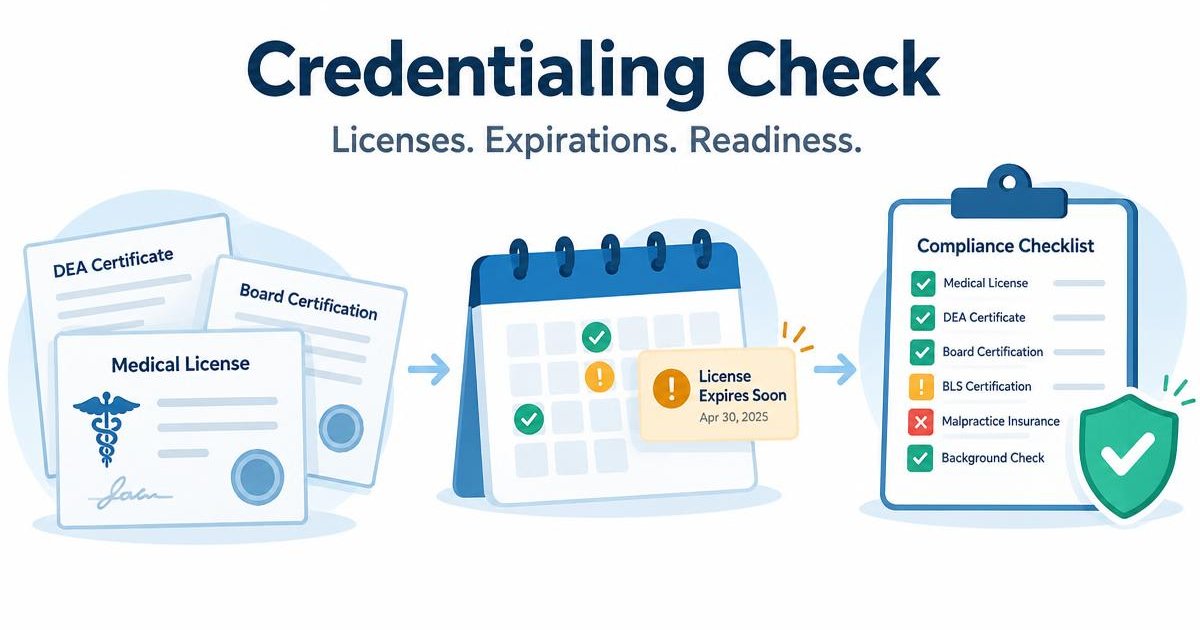
One dashboard per clinician — every license, certification, and document in a single profile with a live compliance status
-
Automatic expiration alerts — reminders emailed to your team and the clinician at 60, 30, 14, 7, 3, and 1 days before expiry, plus a calendar view of every renewal date on the roster
-
Clinician self-service uploads — clinicians upload their own renewals, which land in a Pending Review queue for your team to verify
-
Verification tracking built in — who checked each document, when, and by what method, ready for any audit
-
A client portal — hospitals see the credential status of the clinicians you choose, read-only, instead of you emailing PDFs all day
The honest test
Ask three questions about your current system:
-
If your credentialing coordinator quit tomorrow, would anyone know which licenses expire next month?
-
Could you prove, in under five minutes, who verified every document for your last hospital audit?
-
Does your system warn you before an expiration — or do you find out from the hospital?
If any answer is uncomfortable, the spreadsheet has already failed you. You just may not have paid for it yet — and the price of finding out late is steep.
Credentialing Check is that middle ground — purpose-built for staffing agencies, live in minutes, and free for up to 5 clinicians: https://credentialingcheck.com
Not ready to switch? Start with the free Clinician Credentialing Checklist — the complete list of what to track per clinician, whether you track it in our dashboard or your own.